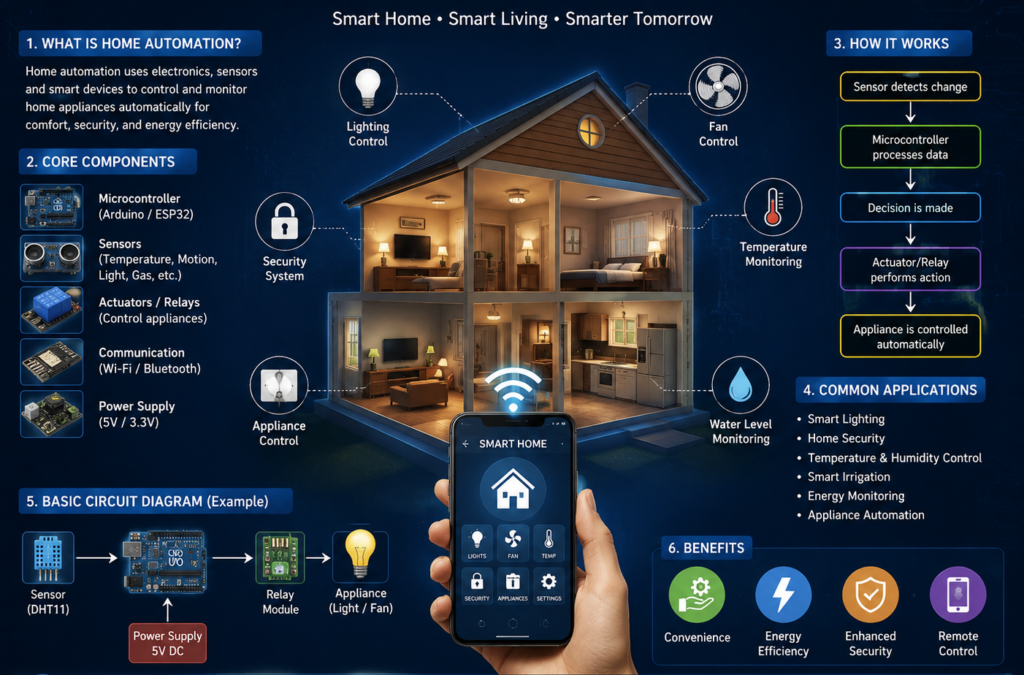
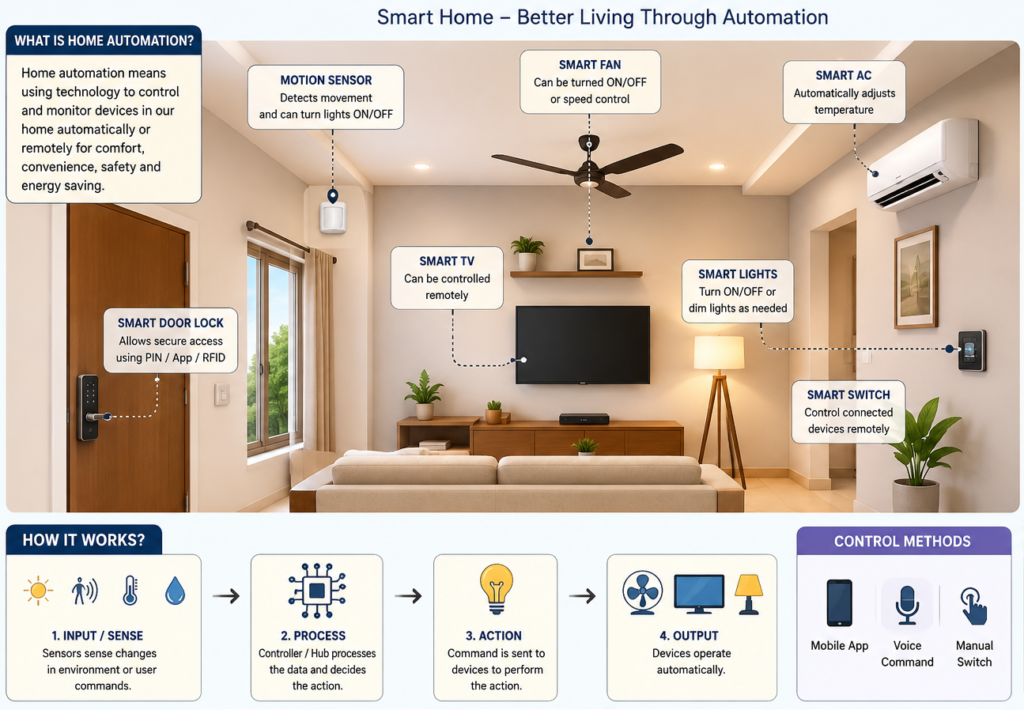
Automation refers to using technology to operate everyday devices automatically without constant manual human intervention. Instead of manually turning switches on or off, automated systems rely on sensors, controllers, and programmed instructions to execute tasks independently.
Core Goals: Reducing repetitive physical effort (drudgery), conserving energy, lowering operational costs, and improving convenience and safety
Examples:
- Classroom Energy Management: Automated lighting powered by motion sensors that automatically shuts off power when no human presence is detected in a room.
- Automated Agriculture/Irrigation: Soil moisture sensors detecting dry ground and signaling a water pump to irrigate crops until optimum soil moisture is reached, eliminating water waste
Bio-Inspiration: Nature as the Original Automated System
Bio-inspiration means taking ideas from nature to create smart machines, tools, or automated systems that can work efficiently with little or no human control. Long before humans created machines, nature perfected autonomous systems. Automated engineering frequently draws inspiration from biological processes and natural patterns such as Automatic street lights (inspired by the eye’s response to light), Automatic doors (motion sensing), Smart irrigation systems (soil moisture sensing, similar to plants’ water needs) etc.
Historical Timeline of Automation
Automation is often perceived as a modern marvel, yet its roots reach back centuries to our first attempts at mastering the twin currents of time and labor. From the rhythmic drip of ancient water clocks to the sprawling, self-correcting energy grids of contemporary smart cities, the human drive to create autonomous systems has remained a constant thread in our history. By decoding the evolution and underlying logic of these machines, we can better navigate a world increasingly defined by the “if-then” logic of the machine. This guide serves as a philosophical and technical map to the most impactful takeaways from the history and mechanics of automation.
Automation is an Ancient Human Story, Not Just a Modern One
Automation did not begin with the silicon chip; it began when we first sought to delegate our observations to the physical world. In antiquity, innovators harnessed natural elements—the steady descent of water or the shifting of solar shadows—to track time. By the Medieval period, this shifted toward the complex elegance of mechanical gears and springs. However, the true philosophical bridge to the modern era was the Industrial Revolution’s Jacquard Loom. This represented a pivotal transition from mere mechanization (like the steam engine) to encoded logic, using punched cards to dictate complex patterns.
While the 20th century eventually introduced micro-computing, transitioning us from physical mechanisms to the digital logic of the electron, our fundamental desire remains unchanged. We have simply evolved from mastering the heavy weight of water to mastering the invisible flow of data.
“The evolution of automation represents a journey from basic mechanical timekeeping to the sophisticated artificial intelligence managing our modern urban landscapes.”
Automation Cycle
Every automated machine operates on a continuous 3-stage loop known as the Automation Cycle:
   [ INPUT ]             [ PROCESSING ]            [ OUTPUT ]
(Sensors detect)  --->  (Microcontroller)  --->  (Actuators perform)
 environmental         evaluates signals &        physical tasks
    stimuli               executes code
- Input (Sensing): Environmental stimuli (such as heat, sound, motion, or light) are converted into electrical signals by dedicated sensors (e.g., PIR motion sensors, LDRs, temperature sensors).
- Processing (Decision Making): A programmable microcontroller (such as an Arduino Uno) reads incoming sensor data, evaluates it against programmed logic (code scripts), and determines the appropriate response.
- Output (Action/Execution): Hardware output devices (such as LEDs, buzzers, relays, servo motors, or LCD displays) carry out physical actions based on commands sent from the microcontroller
The “Lethal vs. Safe” Power Divide
In the laboratory, the most critical philosophical and practical boundary is the divide between high-voltage AC and low-voltage DC power. Most household wall sockets provide 230V AC Mains power, which is life-threatening and strictly prohibited for experimental breadboarding. Conversely, educational electronic circuits are designed to function exclusively on low-voltage Direct Current (DC) supplied by portable 9V batteries or regulated adapters.
Respecting this divide is the first step toward engineering literacy. It is the boundary where a student’s curiosity must be tempered by a disciplined understanding of physical limits to ensure both personal safety and the survival of the equipment.
True engineering excellence begins with the meticulous habit of inspecting wiring paths for loose wires or touching terminal rails before any power is applied.
Essential Safety practice for teachers/students
Safety and precision are not just bureaucratic requirements; they are the prerequisites for innovation.
- 220Ω Resistors: Essential for current control to prevent burning out sensitive components like LEDs.
- Safety Goggles: Non-negotiable protection for the eyes during assembly and soldering.
- Ventilation: Required to safely disperse toxic flux fumes in the workspace.
- Wire Strippers and Cutters: Tools that ensure precise connections and prevent pinch injuries.
- Soldering Iron: A precision heat tool that must be handled with extreme care to avoid burns.
Automation Extends into the Digital Realm
As our machines become nodes in the Internet of Things (IoT), our responsibilities shift from the physical workbench to the digital landscape. “Digital Citizenship” is the modern engineer’s code of conduct. This involves downloading software, such as the Arduino IDE or Tinkercad, only from verified, official sources and maintaining a strict wall around personal identifying information within digital prototyping communities. In an interconnected world, a flaw in your digital behavior is just as dangerous as a short circuit on your breadboard.
Conclusion: The Future of the Cycle
Understanding the “Input-Processing-Output” loop provides the foundational logic required to inhabit a world of AI-managed smart cities, health networks, and energy grids. As the cycle of automation continues to tighten and accelerate, our literacy in these systems becomes our most valuable tool for navigating the future.
To see this loop in action, look around your own home: The next time you adjust your climate control, ask yourself—where is the sensor, and what specific environmental stimulus is it translating into logic to keep you comfortable?
FAQ
Q1. What is home automation?
Answer: Home automation is the use of technology to control home devices automatically or remotely with little or no human effort.
Q2. What are examples of home automation?
Answer: Automatic lights, smart fans, smart door locks, smart air conditioners, automatic water pumps, and security alarms.
Q3.. How is home automation inspired by nature?
Answer: Home automation uses ideas from nature, such as the human eye adjusting to light (light sensors) and the body regulating temperature (thermostats).
Q4. Can home automation save electricity?
Answer: Yes. Devices like smart lights and thermostats switch off or adjust automatically, reducing unnecessary power consumption.
Q5. What is a smart home?
Answer: A smart home is a house where electronic devices communicate and work automatically or can be controlled using a mobile phone or voice commands