
Picture a school hallway just after the final bell. The echoes of footsteps fade, but inside the “Empty Classroom,” the lights hum and fans spin, cooling a room where no one remains. This scenario is a classic study in human forgetfulness, a drain on energy and resources that many adults accept as an inevitability.
However, in modern day, students are seeing this not as a nuisance, but as a problem to be solved through the lens of a visionary maker. By mastering automation—the synthesis of sensors, controllers, and specific computer programs to run tasks independently—these students are redesigning our relationship with the built environment. Our Innovation and skill centre has become the perfect laboratory for our automated future because it is here that technical literacy meets the raw curiosity of the “maker” mind.
Nature Was the First Engineer
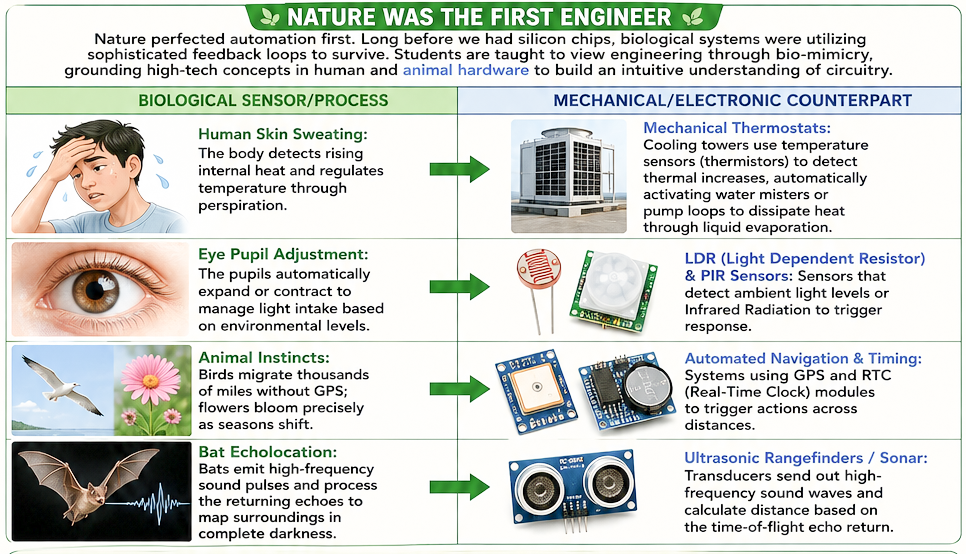
Nature perfected automation first. Long before we had silicon chips, biological systems were utilizing sophisticated feedback loops to survive. Students are taught to view engineering through bio-mimicry, grounding high-tech concepts in human and animal hardware to build an intuitive understanding of circuitry.
| Biological Sensor/Process | Mechanical/Electronic Counterpart |
| Human Skin Sweating: The body detects rising internal heat and regulates temperature through perspiration. | Mechanical Thermostats: Cooling towers use temperature sensors (thermistors) to detect thermal increases, automatically activating water misters or pump loops to dissipate heat through liquid evaporation. |
| Eye Pupil Adjustment: The pupils automatically expand or contract to manage light intake based on environmental levels. | LDR (Light Dependent Resistor) & PIR Sensors: Sensors that detect ambient light levels or Infrared Radiation to trigger response. |
| Animal Instincts: Birds migrate thousands of miles without GPS; flowers bloom precisely as seasons shift. | Automated Navigation & Timing: Systems using GPS and RTC (Real-Time Clock) modules to trigger actions across distances. |
| Bat EcholocationBats emit high-frequency sound pulses and process the returning echoes to map surroundings in complete darkness. | Ultrasonic Rangefinders / SonarTransducers send out high-frequency sound waves and calculate distance based on the time-of-flight echo return. |
By linking the LDR to the human pupil or the PIR sensor to biological motion detection, students develop a “hardware-level intuition.” They see themselves not as creators of something alien, but as apprentices to the natural world.
Read Also : Home Automation
The Universal “Three-Pillar” Logic
Input, Process, Output: The Secret Language of Machines
Whether a student is building a simple alarm or a complex satellite, they must speak the language of the Automation Cycle: Input →Processing →Output. Using the Arduino Uno as the central “brain,” students learn that the logic of the system is the true engine of innovation.
Consider the Smart Irrigation project as example :
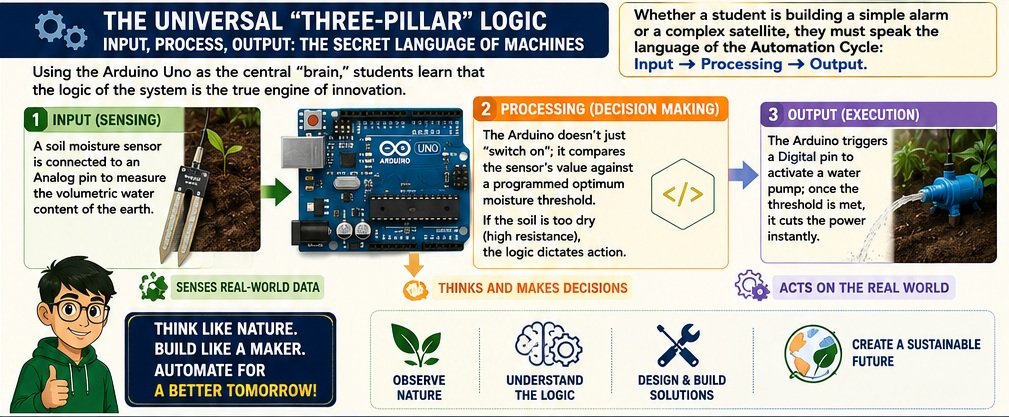
- Input (Sensing): A soil moisture sensor is connected to an Analog pin to measure the volumetric water content of the earth.
- Processing (Decision Making): The Arduino doesn’t just “switch on”; it compares the sensor’s value against a programmed optimum moisture threshold. If the soil is too dry (high resistance), the logic dictates action.
- Output (Execution): The Arduino triggers a Digital pin to activate a water pump; once the threshold is met, it cuts the power instantly.
Pingback: Home Automation - VocationalHub