
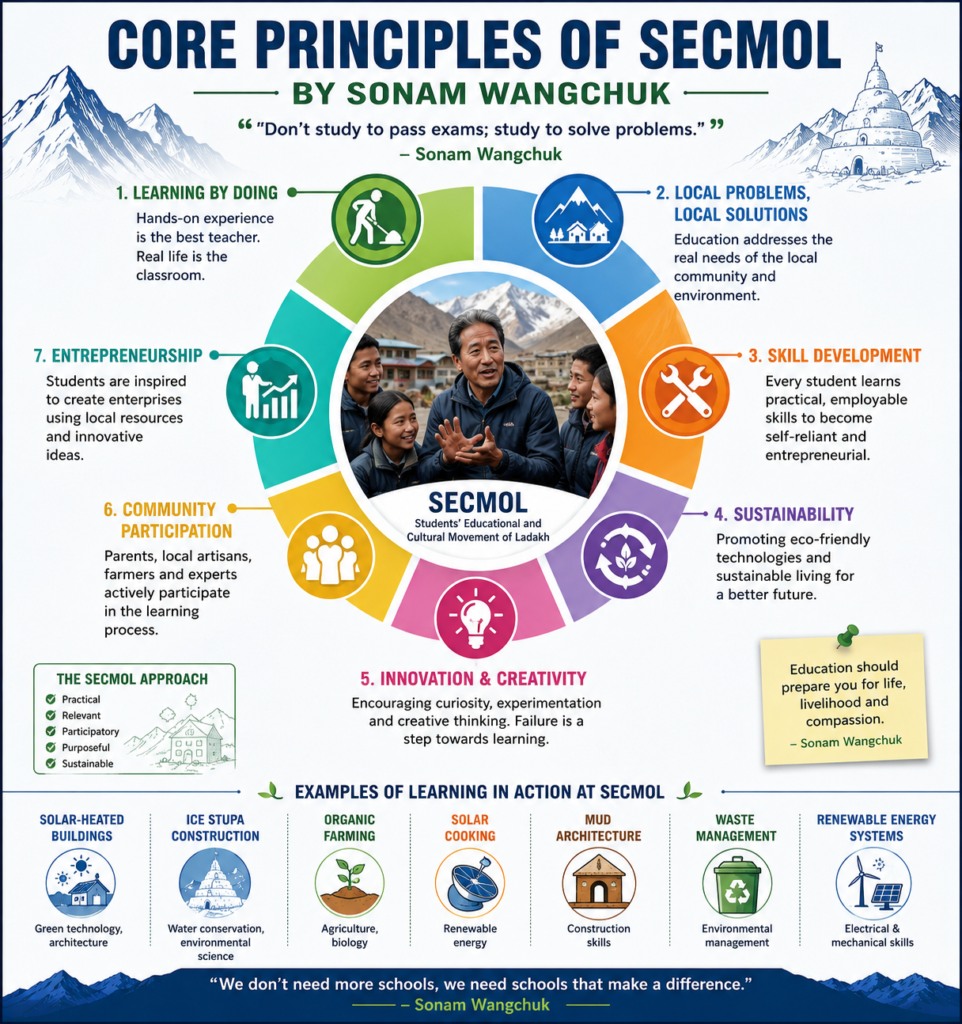
Imagine walking up a flight of stairs where each step is painted to teach you geometry and trigonometry. Imagine opening a door and discovering that its latch is made from recycled materials, designed specifically to demonstrate physics principles like levers and angles.
Welcome to SECMOL (Students’ Educational and Cultural Movement of Ladakh)—a place where school isn’t a rigid, four-walled prison, but a living, breathing laboratory for life.
Founded in 1988 by engineer and innovator Sonam Wangchuk alongside a group of young Ladakhi graduates, SECMOL set out to fix a deeply broken system. Today, it stands as one of the most inspiring examples of educational reform in the world.
In the late 1980s, high school education in Ladakh was in catastrophic shape. Year after year, around 95% of Ladakhi students failed their Grade 10 matriculation exams.
The problem wasn’t a lack of intelligence; it was an alien curriculum.
Children who grew up speaking Ladakhi were forced to study and take exams in English, Urdu, or Hindi. Textbooks imported from warmer regions taught high-altitude mountain children about tropical fans, ocean ships, and trains—things completely foreign to their daily lives in a freezing cold desert. The system labeled these kids as “failures” simply because it failed to teach them in a way that made sense.
Re-Imagining School: Learning by Doing
SECMOL turned traditional education upside down. Instead of forcing kids to memorize dry facts from textbooks to pass tests, they created an alternative campus where learning happens through real-world problem-solving.
Here is what makes their approach so unique:
Admission for “Failures”: SECMOL specifically welcomes students who failed their Grade 10 exams. Instead of punishing them, SECMOL helps rebuild their confidence and self-esteem.
The Campus is the Textbook: Math and science are built directly into the campus architecture. Students learn about the absorption of solar radiation by touching differently colored tiles, and they learn practical biology and agriculture by growing fresh vegetables in solar greenhouses during sub-zero winters.
Student Self-Governance: There are no corporate managers or strict supervisors running daily operations. Students manage the campus themselves—organizing daily tasks, running media channels, managing waste recycling, and making democratic decisions.
Passive Solar Living: The campus buildings are constructed out of low-tech rammed earth and passive solar designs. Even when it drops to -15 °C outside in the Ladakhi winter, indoor temperatures stay around a warm +15 °C heated entirely by the sun, without burning fossil fuels.
Fixing the Mainstream System
SECMOL didn’t just build one isolated alternative campus; they worked directly with the government to reform public education across Ladakh.
Through initiatives like Operation New Hope, SECMOL helped:
- Localize Textbooks: Primary school books were rewritten to include Ladakhi culture, local wildlife, geography, and native language support.
- Train Teachers: Teachers were equipped with activity-based, child-friendly teaching methods rather than relying on fear and punishment.
- Involve Communities: Village Education Committees (VECs) were formed so local parents and elders could take ownership of their village schools.
The Impact? Over time, the Grade 10 pass rate in Ladakh transformed dramatically—climbing from a dismal 5% to 75%.
Why This Matters for All of Us
The story of SECMOL and Sonam Wangchuk offers powerful lessons for education everywhere:
- Practical Wisdom > Rote Memorization: True learning happens when students use their hands and minds together to solve real challenges in their immediate environment.
- Failure is a Systemic Glitch, Not a Personal Flaw: SECMOL alumni—many of whom failed Class 10 multiple times—have gone on to become successful journalists, filmmakers, government officials, and social entrepreneurs.
- Context-Driven Learning: Education must respect and reflect local culture, geography, and language to be truly meaningful.
What do you think?
Could a hands-on, self-governed learning model like SECMOL work in urban schools, or is it best suited for rural communities? Share your thoughts in the comments below!
Good 👍
Thank you