
There is a specific, sinking feeling known to every maker: the distinct smell of “magic smoke” rising from a freshly wired board. It’s the smell of a component dying because a project was started without a plan. We have all been there—a pile of hardware spread across the desk, a soldering iron at the ready, and a gut feeling that we’re just guessing. This is why the circuit diagram is your most valuable asset.
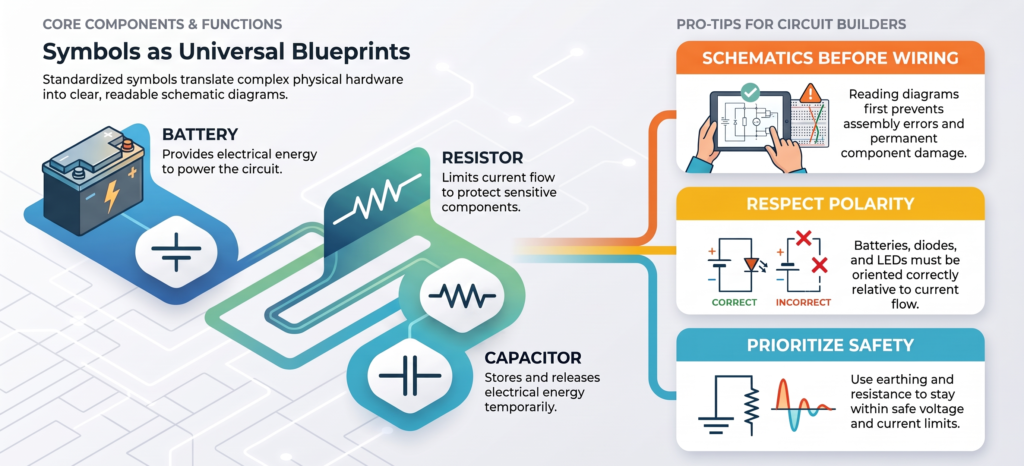
It is the universal blueprint that translates physical hardware into a standardized language of symbols, allowing you to visualize and verify the invisible flow of electricity before you ever commit to a build. Before starting any hands-on electronics project such as home automation, mastering simple circuit diagrams and recognizing the fundamental components that make them work is essential.
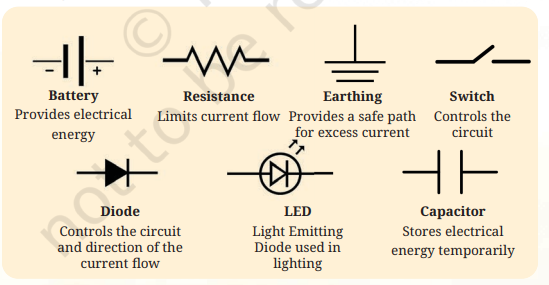
| Component | Primary Function |
| Battery | Provides electrical energy to power the circuit. |
| Resistor / Resistance | Limits current flow to protect sensitive components. |
| Switch | Controls the circuit by connecting or interrupting current flow. |
| Earthing (Ground) | Provides a safe path for excess current to prevent hazards. |
| Diode | Controls the circuit and permits current to flow in one direction only. |
| LED (Light Emitting Diode) | Converts electrical energy directly into light for indicators and illumination. |
| Capacitor | Stores electrical energy temporarily and releases it when needed. |
Frequently asked questions
Question. 1 Why is the Circuit Diagram is Your Best Insurance Policy?
Answer- By transitioning from hardware to symbol, you distance yourself from the clutter of the physical workbench and focus on the logic of the system. This “insurance policy” ensures that when you move to the breadboard or PCB, you are executing a proven design rather than troubleshooting a mess.
Question. 2 How the symbol of a battery indicates its positive and negative terminals.
Answer- The battery symbol uses two parallel lines—a long line for positive and a short line for negative—to indicate where the energy begins its journey.
Question. 3 How does the symbol of a diode show the direction of current flow?
Answer- In Diodes and LEDs, using a triangle pointing toward a vertical bar to show exactly which way current is permitted to flow. The LED symbol adds outward-pointing arrows to represent the light it emits.
Question. 4 What is the function of Capacitor?
Answer- The capacitor acts as a temporary reservoir, storing electrical energy when it’s abundant and releasing it when the supply dips.
Question. 5 What is the function of Earthing(Ground)
Answer- The ground symbol identifies the safe path for excess current to escape, preventing hazardous build-ups of electricity.