
1. Introduction: The Sticker Shock at the Grocery Store
Walk into a high-end supermarket, and you are greeted by perfectly misted produce, neatly stacked in plastic clamshells under bright LED lights. Now, compare that to the local mandi, where vegetables are often covered in the very earth they grew in, sold by weight from a burlap sack. The most striking difference, however, isn’t the lighting—it’s the price tag. A basket of vegetables that costs only a modest amount at the farm gate can become significantly more expensive by the time it reaches the retail shelf due to the value chain.
The “Agricultural Value Chain,” a complex, multi-stage journey where every stop adds cost, labor, and innovation before the product ever reaches your plate.
2. The Mother of All Production
To understand the value chain, we must first recognize that agriculture is not merely a sector; it is the foundational system of human civilization. At its core, the industry is defined by its unique philosophy: “Work with Life Forms.“ This involves a strategic partnership with plants and animals to create the surplus required for a “better life” and industrial growth.
Often referred to as the “mother of all production,” agriculture provides the primary sustenance for our population while acting as the vital organ for global industry. Beyond the food on our tables—the pulses, wheat, and spices—it supplies the critical raw materials for a vast array of sectors:
- Textiles: Cotton and jute fibers.
- Manufacturing: Wood, rubber, and leather.
- Consumer Goods: Essential oils, tea, and coffee.
Modern life is built upon these primary biological processes. Without the calculated cultivation of crops and the rearing of livestock, the industrial and technological advancements we enjoy today would lack their most basic inputs.
3. The Journey of Value: Why Produce Price Escalate
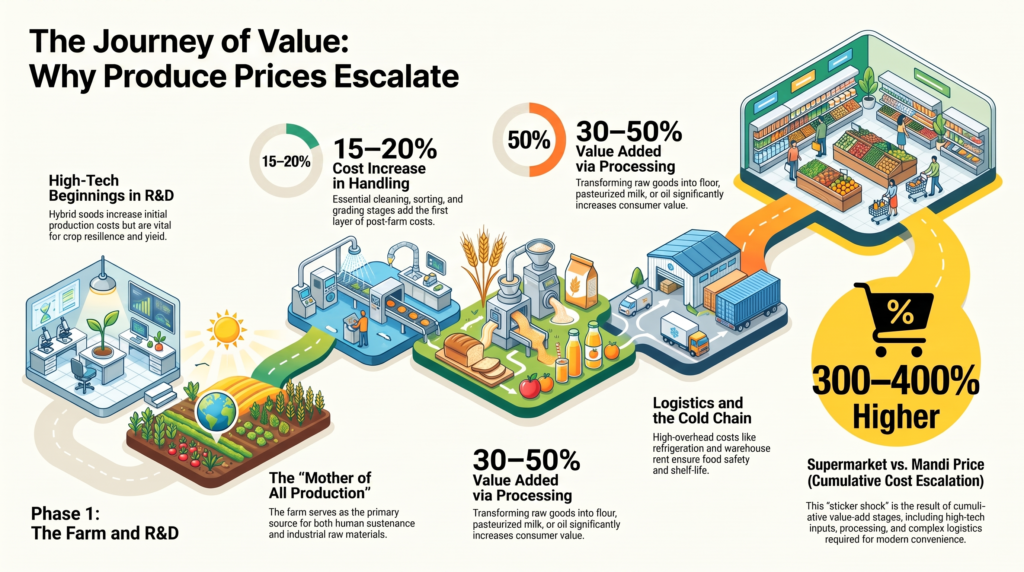
The “Value Chain” is the mechanism by which the price of produce escalates as it moves further from the soil. In India, supermarket prices can be 300–400% higher than mandi prices. This “sticker shock” is not arbitrary; it is the result of cumulative value-add stages and high-tech inputs.
The journey begins with Research and Development (R&D). The use of hybrid seeds, for example, increases the initial cost of production but is necessary to ensure yield and resilience. As the produce leaves the farm, costs accumulate rapidly:
- Post-harvest Handling: Cleaning, sorting, and grading add an initial 15–20% to the cost.
- Processing: Transforming raw goods—such as grinding wheat into flour, pasteurizing milk, or extracting oil—adds another 30–50% to the value.
- Logistics and the Cold Chain: Refrigeration, warehouse rent, and transport are high-overhead costs required to maintain safety and quality.
From a consultant’s perspective, “value” in the consumer’s eyes is often synonymous with convenience and shelf-life, both of which require significant capital investment to achieve.
4. The Livelihood Ecosystem: A Web of Connection
Agriculture is a collective social effort, a “livelihood ecosystem” where no work is done in isolation. This is an interconnected network of people and institutions; a shift in consumer demand for “sustainable” or “organic” crops necessitates a complete pivot of the entire research-to-retail pipeline.
This ecosystem thrives on the collaboration of diverse specialists:
- Scientists & Experts: Soil scientists, agronomists, and veterinarians.
- Tech Innovators: Drone operators, data analysts, and agricultural equipment manufacturers.
- Environmental Stewards: Forest officers and conservationists.
When demand for a specific crop fluctuates, the ripple effect is felt by everyone from the researcher developing the seed to the transporter moving the final product. Agriculture is a complex system requiring strategic intervention at every node.
5. Dancing with the Climate: The Tech-Enhanced Farmer
Optimizing production requires mitigating climate risk. In regions like Ladakh, the “cold desert,” the stakes are exceptionally high. Farmers there operate within a narrow sowing window (May to September) and must manage extreme conditions. Technical data reveals that while average humidity stays between 70–74%, any significant drop can lead to high evaporation losses from leaves and rapid soil dryness, potentially destroying weeks of labor.
To navigate these challenges, modern farmers rely on the India Meteorological Department (IMD) and digital platforms like the Bharat-VISTAAR app and Gramin Krishi Mausam Sewa (GKMS). These tools track temperature, precipitation, and wind direction, but their utility extends beyond crops. For a consultant focused on sustainability, a key insight is that IMD data is now used to predict livestock disease outbreaks, allowing for timely preventive action.
6. Quality Control: The Science of Soil and Seeds
High-value output is the result of rigorous technical work beneath the surface. Success depends on optimizing nutrient absorption through soil science and ensuring high germination rates.
Optimizing Soil Health A consultant must analyze soil texture and pH to provide actionable advice. For instance, if soil texture results show a clay percentage of more than 20%, the resulting waterlogging will suffocate roots; this requires adding river sand to improve drainage. Conversely, if sand exceeds 80%, the soil cannot hold water, leading to plant wilting. Farmers must also manage pH levels (ideally 6–7):
- Acidic Soil (pH < 6): Requires amendments like lime, wood ash, or compost.
- Alkaline/Basic Soil (pH > 8.5): Requires “soil washing” (adding and draining extra water) or adding gypsum and organic matter.
Precision Seed Treatment Before sowing cereal crops like wheat and rice, the “Floating Method” is used to identify viable seeds:
- Place seeds in a salt-water solution (NaCl).
- Wait 3–5 minutes for the density difference to take effect.
- Identify and discard damaged, infected, or hollow seeds that float.
- Wash the remaining healthy seeds in fresh water before drying and sowing.
This scientific approach bridges the gap between modern soil science and traditional wisdom. The ancient text Kṛiṣhi-parāśhara remains relevant today, specifically for its insights into natural ecology as a means to combat the modern overuse of chemical fertilizers and soil degradation.
7. Modern Tech Meets Ancient Wisdom
The agricultural sector is currently undergoing a strategic transformation into “Precision Farming.” This is the fusion of advanced technologies—drones, AI, robotics, and sensors—with traditional “natural farming” practices.
The use of solar pumps for sustainable irrigation and market price apps to empower farmers are prime examples of how technology reduces the depletion of natural resources. This hybrid approach is the only viable path forward to address the twin challenges of climate change and shrinking arable land.
8. A Final Thought for the Conscious Consumer
Agriculture remains the backbone of the Indian economy, contributing 16% to the GDP and employing 46.1% of the workforce. It is a sector defined by resilience and constant innovation.
The next time you reach for a polished apple or a bag of flour in a supermarket, consider the journey it took to get there. Understanding the agricultural value chain reveals the massive, collective effort of scientists, tech operators, and farmers.
Frequently Asked Questions
- What is a “livelihood ecosystem” in the context of agriculture?
A livelihood ecosystem is an interconnected network of people, resources, institutions, and environmental factors that allow individuals to earn a living. It ensures that no work is done in isolation, as changes in one area, such as market demand, eventually impact all other connected stakeholders like transporters and equipment manufacturers.
- How does the agricultural sector function as the “mother of all production”?
Agriculture is considered the “mother of all production” because it is the primary source of sustenance for human civilization. It provides essential raw materials—such as cotton, leather, rubber, and wood—to a wide variety of raw materials to the industries.
- Why is the concept of a “value chain” ?
The value chain illustrates how the cost of agricultural produce increases as it travels further or undergoes more processing. Understanding this chain helps consumers make informed choices by comparing the costs of buying directly from farms or mandis versus supermarkets.
- What are the primary factors that contribute to the increase in value as produce moves through the chain?
Value is added at each step due to the costs of additional processes such as refrigerated storage, warehouse rent, and transportation. Furthermore, processing activities like grinding wheat into flour, cleaning, pasteurization, and profit margins for various stakeholders also increase the final price.
- Explain the interlinkages between different types of agricultural work and how a drop in demand affects other stakeholders.
Work in agriculture is deeply connected; if the demand for a specific produce decreases, the farmer is not the only person affected. Over time, the requirement for transport services, the production of agricultural equipment, and the need for agricultural experts will also decrease.
Does knowing the depth of the “real” work and the scientific precision behind your food change how you value your next meal? comment here….