
The Golden Handcuff Dilemma
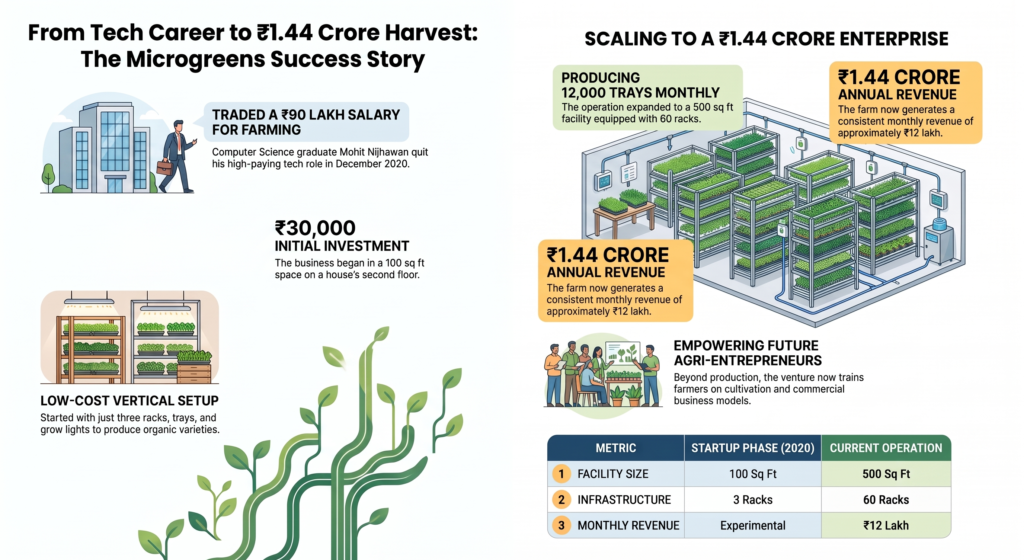
In December 2020, while the world was gripped by pandemic uncertainty, Mohit Nijhawan walked away from the ultimate corporate safety net: a ₹90 lakh annual salary. A B.Tech graduate in Computer Science, Nijhawan chose to pivot from the world of bits and bytes to the precision of agritech, trading a high-status office for a dirt-less indoor farm. His journey from a tech specialist to a high-yield entrepreneur highlights a radical shift in how we define a “green” career—proving that a background in engineering is the perfect foundation for optimizing the unit economics of urban agriculture.
Read Also-Decoding the Journey of the Agricultural Value Chain
You Don’t Need a Fortune to Start a Fortune
A common myth in the startup world is that agricultural ventures require massive capital and sprawling acreage. Nijhawan’s launch of Greenu Microgreens is a masterclass in bootstrapping. He entered the market with a lean investment of just ₹30,000, which covered his initial essential hardware: racks, trays, grow lights, and seeds. By starting in a modest 100-square-foot space on the second floor of his home, he successfully de-risked the venture.
Entrepreneurial Analysis: This low-cost entry allowed Nijhawan to master the learning curve—spanning cultivation, production, and customer acquisition—without the pressure of servicing heavy debt. For the modern entrepreneur, the lesson is clear: focus on proof of concept in a micro-environment before seeking to scale.
The Math of Micro-Scale Productivity
The transition from a home experiment to a commercial operation demonstrates the power of vertical scalability. By maximizing vertical space rather than horizontal land, Nijhawan has achieved an output density that traditional farming cannot touch.
Official Growth Record from Greenu Microgreens: “He established a vertical indoor farm using three racks, trays, grow lights, and seeds, initially focusing on 21 organic varieties and strictly adhering to non-GMO, pesticide-free methods. Since then, Greenu Microgreens has grown significantly. The operation now spans a 500 sq ft facility, equipped with about 60 racks capable of producing 12,000 trays per month.”
Entrepreneurial Analysis: To understand the brilliance of this model, look at the revenue density. Generating ₹12 lakh monthly from a 500-square-foot facility equates to a staggering ₹2,400 per square foot per month. This high-efficiency indoor farming model is a total game-changer for urban entrepreneurs, turning small city footprints into high-revenue assets through vertical optimization.
High-Value Specialization Trumps Traditional Bulk
Instead of competing in the saturated, low-margin traditional vegetable market, Nijhawan focused on microgreens—young, nutrient-dense plants positioned as a premium superfood. By specializing in 21 organic, non-GMO, and pesticide-free varieties, he leveraged a “high-value niche” strategy.
Entrepreneurial Analysis: In entrepreneurship, specialization dictates margins. By focusing on high-density, high-value crops, Nijhawan achieved a ₹1.44 crore annual revenue run rate. This proves that in the modern economy, the specific value of your output and the quality of your niche are far more important for ROI than the physical size of your production facility.
The Pivot from Employee to Educator
A truly sustainable business model doesn’t just extract value; it builds an ecosystem. Nijhawan has expanded his operations to include a training arm, mentoring farmers and aspiring entrepreneurs. Crucially, his curriculum focuses not just on the technical nuances of cultivation, but on the “commercial side”—the business of farming.
Entrepreneurial Analysis: This transition from a solo operator to an industry educator is a strategic move that builds brand authority and diversified revenue streams. By teaching the commercial side, Nijhawan is addressing the biggest failure point in agritech: the gap between knowing how to grow and knowing how to sell. Building an ecosystem is the ultimate sign of a scalable, future-proof business.
A New Definition of Growth
Mohit Nijhawan’s evolution from a computer science engineer to a ₹1.44 crore agritech pioneer proves that the most valuable tool in modern farming is a strategic, analytical mindset. By applying technical precision to indoor agriculture, he transformed a corporate exit into a thriving, high-yield enterprise.
The question for the modern professional is no longer about the size of the corporate ladder, but the potential of the ground beneath your feet. Does your “100-square-foot” opportunity already exist in your own home, and are you willing to trade a traditional “dream” for a path you design yourself?
Source-NDTV News