For decades, the standard path through school looked remarkably uniform: sit at a desk, memorize textbooks, pass standardized exams, and hope that workplace skills would somehow manifest on the job.
However, real-world challenges rarely look like multiple-choice questions.
What Exactly Is Vocational Education?
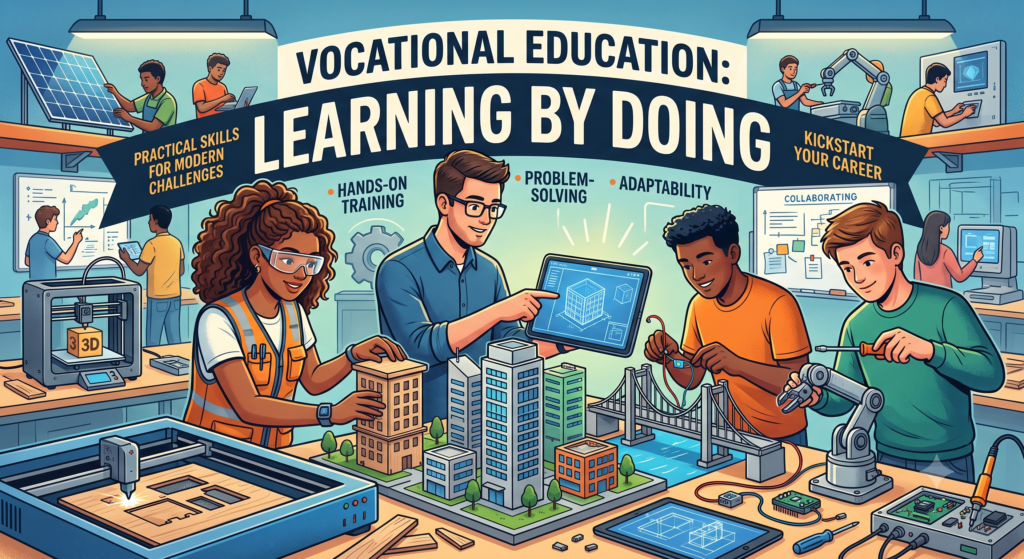
Vocational education centers on the principle of learning by doing. Rather than focusing solely on textbook theories, it equips you with the practical skills needed to solve modern-day challenges. This hands-on training emphasizes design thinking, problem-solving, adaptability, and transferable capabilities in tandem with technical expertise, providing the direct experience necessary to immediately kickstart a career or launch your own business.
It cultivates critical soft skills alongside practical capabilities:
- Design Thinking & Problem Solving: Testing real hypotheses and troubleshooting tangible systems.
- Adaptability & Transferability: Learning core principles that apply across fast-moving industries.
- Direct Career Readiness: Providing the foundational skills needed to enter skilled professions or launch entrepreneurial ventures early.
The Wake-Up Call: Understanding the Global “Skilling Gap”
Why the sudden shift toward making vocational skills mandatory? The answer lies in global economic reality.
To drive economic growth, converting the population into a globally competitive workforce is essential. While India possesses one of the youngest working-age populations in the world, only around 3–5% of the Indian workforce has received formal vocational training, compared to ~75% in Germany and ~80% in Japan. Consequently, making vocational skills mandatory is not a mere educational preference—it is an economic and social imperative driven by the realities of the modern world.
Pillars of the NCF-SE Vocational Shift
Integration into Regular Classes
Job training is no longer an optional side activity or a fallback track for non-academic students. It is being woven directly into daily schedules alongside traditional subjects like mathematics, literature, and science.
Early Skill Discovery
Students gain foundational exposure to hands-on work starting in middle school (Grades 6–8). This early introduction helps students discover their natural aptitudes and interests long before choosing career paths in higher grades.
Removing Social Stigma
By making skill-based training mandatory for everyone, the framework promotes dignity of labor. Whether learning digital design, basic robotics, sustainable agriculture, or healthcare basics, all students gain equal appreciation for diverse forms of work.
Way Ahead
The future of education lies in learning by doing. Making vocational skills compulsory bridges the gap between theory and execution—turning students into agile problem-solvers, bold innovators, and the next generation of entrepreneurs.